Project PID2021-123686OB-I00 · University of the Basque Country UPV/EHU
Behaviour is the missing half of climate policy
What 24 experiments and surveys with more than 14,000 participants tell us about carbon pricing, climate communication and the demand side of the energy transition.
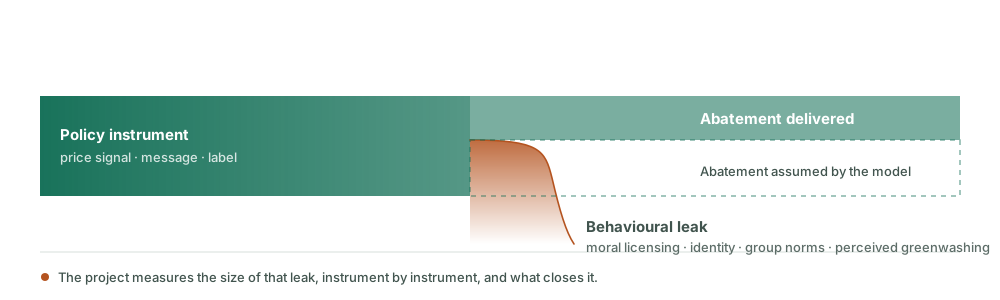
In numbers
An evidence base built to be checked, not to be taken on trust.
The data behind every figure are deposited in open access in Zenodo and the Open Science Framework, under a CC BY 4.0 licence.
Findings
Ten results that change how policy should be designed.
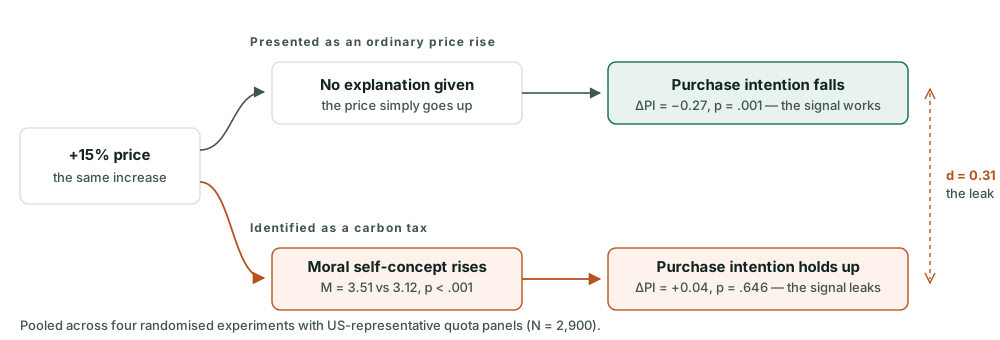
The mechanism, in one diagram
The project's central result is not that carbon pricing fails. It is that the same increase behaves in two different ways depending on how it is presented, and that the difference runs through a moral route rather than an economic one.
And, from the project's most recent study
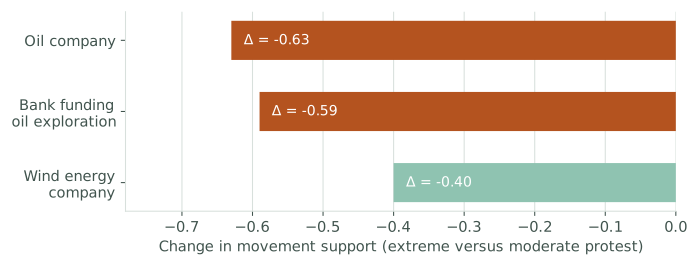
Extreme protest reduces support for the climate movement whoever it targets — but what the public withdraws is support for the activists' actions, not for the cause. Target choice interacts with the audience's politics: protests against a wind energy company cost most with the audience most disposed to support the transition.
Toolbox
For each instrument: the intended mechanism, the response we observed, and the design fix.
| Instrument | Observed response | Design implication |
|---|
The report sets out thirteen instruments and states, for every row, the design behind it: randomised experiments support causal claims about the manipulated treatment; cross-sectional surveys support associations only.
Recommendations
Ten propositions addressed to the people who decide.
Publications
The evidence is published, and almost all of it is open access.
The primary sources are listed here; the report's evidence base lists them all. Across the project the team published thirty-two peer-reviewed articles and nine book chapters. Accepted versions are deposited in ADDI, the UPV/EHU institutional repository.
Work with us
The project has ended; the research capability has not.
If your organisation is designing an instrument, a campaign or a labelling format, we can test it before it is deployed. Tell us what you are working on and we will come back to you.